Wednesday, 7 January 2015

Jan. 7 – Magnetism

Here's the schedule for the remainder of the term:
  • Last Lesson: Monday, Jan. 12
  • Mini Test: Thursday, Jan. 15
  • ISP Due: Monday, Jan. 19
  • Exam: Monday, Jan. 26

Magnetism


Magnetism is an intrinsic property of some particles, like charge or mass.
Magnets exert forces on other magnets.

Like poles repel  N-N  or S-S
Unlike poles attract   N-S  or S-N

Permanent Magnets


Have a North and South pole.
We draw magnetic field lines to show the direction that a compass would point: away from the N and towards S.
 - field lines never cross.
 - lines get further apart as they leave the magnet.


Poles only exist in pairs.  No such thing as a “monopole”.  If you break a magnet in half, you get two magnets.

The Earth has a magnetic field that protects us from charged particles coming from the sun.


When these particles hit the Earth's atmosphere (at the poles) they create auroras.


Magnetic fields are measured in Teslas.


Ferromagnetic Materials

Some materials, like iron, are made up of magnetic domains.  Many domains point in different directions cancel each other out.

An external magnetic field can line up the domains and make the material behave like a permanent magnet.  (temperature also affects domains)


Electromagnets

When current passes through a conductor, magnetic fields form.  We use the right-hand-rule to predict the direction of the field.

Ex: Current on a wire.
Thumb points in direction of I.
Fingers show direction of B (magnetic field).


At this point, it is useful to use these symbols to draw vectors in 3D:


Ex: Wires coiled into loops can create a magnetic field that looks exactly like a permanent bar magnet.  This is called a solenoid.


Right-hand-rule for solenoids.
 - wrap your fingers in the direction of the current.  Your thumb will point to the N.


Electromagnets are useful for many applications.


Monday, 5 January 2015

Jan. 5 – Power in Circuits

Welcome back from the break!

Remember, there's a quiz tomorrow!

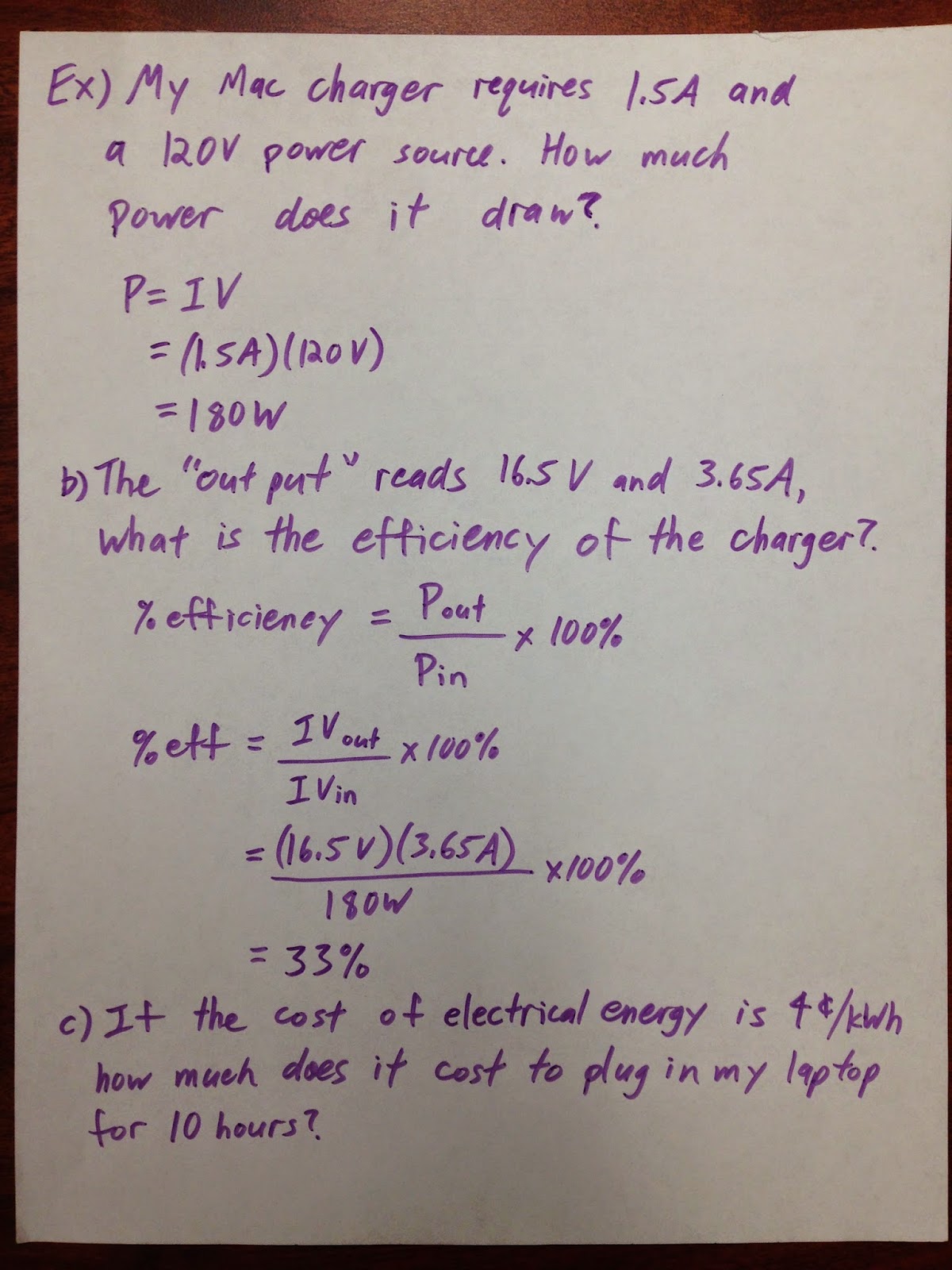
Here's the new notes from today:


And here are the solutions to the review worksheet:

Saturday, 20 December 2014

Dec. 19 – Circuits

Last time we talked about Ohm's Law, V = I R.  Which one of these graphs best represents Ohm's Law?


The answer is (a).  If you graph voltage vs. current, and you get a linear graph, that means Ohm's law is obeyed.

Ohmic - the material obeys Ohm’s Law (V vs I graph is linear).

Non-Ohmic - the material does not obey Ohm’s Law (V vs. I graph is curved).

We will always assume Ohmic resistors.

Circuits

Circuits are closed paths for charges to flow.

An analogy of circuits as a roller coaster ride.

Here's what circuits look like in real life.  Every line on the board is a wire.
Conventional current flows from + to –.  Electron flow is opposite ( – to + ).


AC - Alternating Current, direction constantly changes, no + or –.
DC - Direct current, charges only move in one direction.

In this course, we will only be working with DC circuits.

Types of Circuits

Series
 - components are connected with one path
 - total resistance is the SUM of each resistance.


  • The current is the same for all resistors connected in series.


Parallel
 - components are connected with multiple paths for charges to flow.
 - total resistance is the INVERSE SUM 


    • The voltage is the same for all resistors connected in parallel.

    Using these rules, we can replace a set of resistors with an equivalent resistor

     Mixed Circuits
     - contains combinations of components in series or parallel
     - total resistance must be calculated one section at a time


    Kirchhoff's Laws


    Kirchhoff's Current Law

    Also known as the junction rule.
     - All current entering a location must exit that location.
     - Current in equals Current out.
                I in   =  I out


    Kirchhoff’s Voltage Law

    Also known as the loop rule.
     - The potential difference around a loop must be zero.
               V1 + V2 + V3 + … = 0 


    Handout

    Here are some challenging circuit questions that are more difficult than the ones in your text book.


    Thursday, 18 December 2014

    Dec. 18 – Speaker Project

    Today we assigned the ISP!  You and your group will have to build a speaker!

    Handout


    Here's a video to help you get started.  You do not need to follow this video!  Use whatever resources you want and whatever design works for you and the materials you have.


    Wednesday, 17 December 2014

    Dec. 17 – Unit 5: Electricity and Magnetism

    Schedule for the next few classes...

    • Today: New Unit
    • Tomorrow: ISP assigned, work period, bring laptops/tablets.
    • Friday: Lab Due.
    • Jan. 5: Welcome back.
    • Jan. 6: Quiz on Circuits


    Unit 5: Electricity and Magnetism

    What is charge?

      - can be positive, negative, or neutral.
      - a source of electric field (force) and also reacts to that force. (ie. charges exert forces on each other).
      - the smallest charge is 1 electron (or proton) = 1.602 x 10 ^-19 C
      - C is Coulombs, units of charge.
      - Unlike gravity, charges attract or repel.

    Electric Potential

    Electric forces can do work.  Therefore, there is a form of electric energy.  We call it electric potential energy.

    The electric potential energy per Coulomb is called “voltage”.  Also called electric potential, or potential difference.

    V = ∆E/q

    Units are "volts", 1 V = 1 J / 1 C

    Like gravitational potential, zero can be at any point, only differences matter.  Often written as ∆V.

    Current

    The movement of charges.

    I = Q/∆t

    Units are "amperes", 1 A = 1 C / 1 s

    Ohm’s Law

    Potential difference makes charge flow, but the flow is restricted by resistance.


    Example: 

    A flashlight requires 4 AA batteries (1.5 V each).  If the bulb has 500 Ω of resistance, what current goes through the bulb?

         I = V ÷ R  = (1.5 A x 4) ÷ 500 Ω = 0.012 A = 12 mA

    b) If the same bulb is plugged into a wall socket (120 V), what current is drawn?

         I = V ÷ R  = 120 V ÷ 500 Ω = 0.24 A = 240 mA

    Most houses have 15 A “breakers” for safety.

    Example:

    A TASER can deliver up to 50 000 V through the air.  Once it contacts you, the voltage drops to 1200 V.  A wall socket provides 120 V.  Which is more dangerous?


    The resistance of a human depends on the point of entry, moisture, tissue, etc.

    Dry skin, R = 100 000 Ω
    Broken skin, R = 1000 Ω

    Use broken skin and a wall socket.
    I = V/R              I = 120 mA

    Taser.
    I = V/R             I = 1.2 A

    Looks like a Taser is more dangerous… why doesn’t it kill you?  Remember, current is charge/second, if you have limited charge, you have limited current.

    A taser has limited charge in the battery.
    Taser claims to deliver 0.002 A up to 0.03 A.

    Wall socket has unlimited supply of charge.


    Handout


    Monday, 15 December 2014

    Dec. 15 – Review and Study Period

    Hi Everyone,

    I hope your studying for your test is going well.  Many people have asked me for extra questions, so here are a few to tie you over until the test tomorrow:

    Make sure to get some rest before the test as well.

    Good luck!

    Friday, 12 December 2014